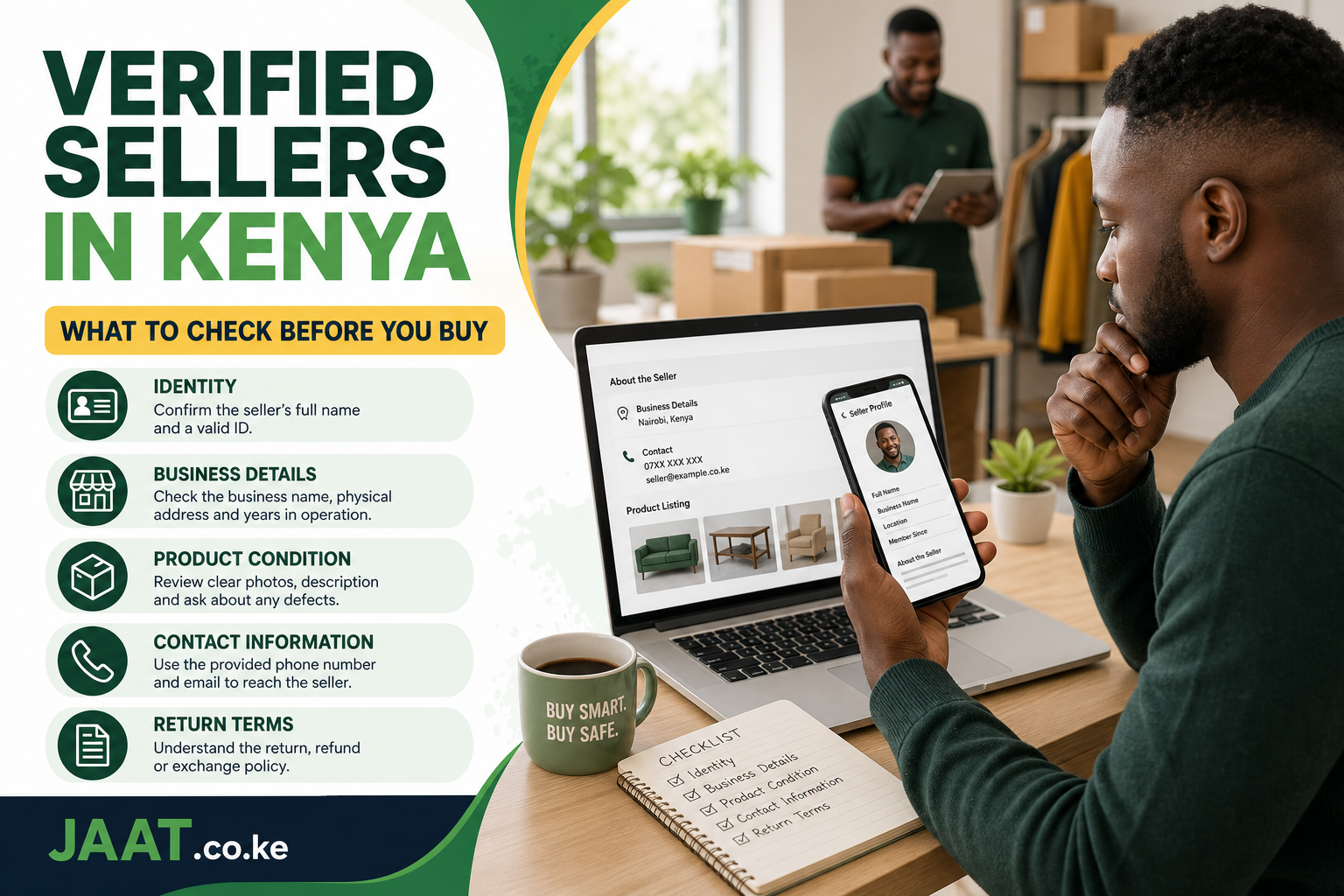
The phrase verified sellers in Kenya appears reassuring. It suggests that someone has checked the person or business behind a marketplace profile. But verification is not one universal process. One platform may confirm only a phone number. Another may privately review identity documents. A third may check business registration, physical location, product listings or transaction performance. All of these can be called verification, yet they give buyers very different information.
That distinction matters because a profile-level check cannot answer every transaction-level question. A real person can publish an inaccurate listing. A registered company can run out of stock. A genuine shop can misunderstand a product specification. An established seller's messaging account can be impersonated. Verification can reduce uncertainty when it is clearly designed and explained; it cannot replace the buyer's need to confirm the exact product, price, payment recipient, delivery arrangement and after-sales terms.
This guide explains what seller verification should mean in a Kenyan online marketplace and how buyers can interpret it responsibly. It breaks verification into layers, shows what a badge can and cannot establish, provides a detailed buyer checklist and offers category-specific checks for common purchases. It also explains how honest sellers can become easier to verify and what marketplaces should disclose if they want trust labels to be useful rather than merely decorative.
Table of contents
- Why verification language needs precision
- The seven layers of seller verification
- What verification does not guarantee
- How to interpret a verified badge
- Verification changes through the buying journey
- The Kenyan buyer's seller-verification checklist
- Verify the transaction as well as the profile
- Category-specific verification checks
- Payment, delivery and collection checks
- Impersonation and account-takeover warning signs
- How responsible sellers can become more verifiable
- What a marketplace verification policy should explain
- How to approach verification on JAAT
- Frequently asked questions
Why verification language needs precision
Trust labels influence decisions. A buyer comparing two similar phone listings may choose the profile carrying a check mark. A customer looking for an electrician may disclose their location to someone described as verified. A business purchasing equipment may pay a deposit because a seller appears to have passed platform checks. If the meaning of the label is unclear, the buyer can assume protection that does not exist.
Useful verification answers four questions: what information was checked, how it was checked, when the check occurred and what the label does not cover. “Phone number confirmed on 12 July” is narrow but clear. “Business registration and authorised representative reviewed” communicates a different level. A generic word without a definition leaves the buyer to invent the meaning.
Privacy must remain central. Proper verification does not mean publishing a seller's national identification card, tax document, home address or personal number for everyone to download. Sensitive evidence should be collected for a legitimate purpose, protected and retained only as appropriate. Buyers need a meaningful outcome from the check, not access to raw personal documents that could enable identity theft.
The seven layers of seller verification
A strong system can contain several independent layers. Understanding them helps buyers ask better questions.
1. Contact verification
The platform confirms that the seller controls an email address or phone number, often through a link or one-time code. This reduces typing errors and some automated abuse. It does not prove the person's legal identity, business status, location or right to sell a product. Contact verification is a useful minimum account-security step, not a complete trust assessment.
2. Identity verification
The platform privately compares a person with acceptable identity evidence and may use a live image or other anti-impersonation check. The exact process matters. A document upload by itself can be stolen or altered; a stronger process checks validity and matches the account holder appropriately. Even then, identity verification establishes who opened or represents the account, not whether every listing is genuine.
3. Business verification
For a company or registered enterprise, the platform may review business registration details, trading name, relevant tax information, authorised representative or official contacts. This can help distinguish a real legal entity from someone borrowing its name. Buyers should know whether the platform merely received a document or checked it against an authoritative source. Business verification does not prove that the company is an authorised dealer for every brand it lists.
4. Location verification
A seller may verify a public shop, office, workshop or service area. Methods can include suitable documents, map evidence, a visit or other review. The badge should distinguish a customer-facing premises from a private operating address. Location verification can support traceability, but it does not mean buyers should arrive without confirming hours and access.
5. Listing verification
The platform reviews a specific product or service listing for required information, prohibited content or evidence. For high-value goods, this might involve real photographs, model details, condition disclosure or proof that the seller has access to the item. A listing check is more relevant to the purchase than identity alone, but stock and condition can change after review. The label should show its scope and recency.
6. Transaction verification
Where ordering or payment happens through the marketplace, the platform can connect the buyer, seller, item, amount and fulfilment record. It may confirm that an order exists or that a payment reached a specified process. The protections available depend on written terms. Transaction verification is not the same as an unconditional refund promise, and direct payments outside the defined process may not be covered.
7. Performance verification
The marketplace may use completed-order history, delivery outcomes, response behaviour, complaint records or genuine customer reviews to indicate ongoing performance. This can be valuable because it reflects activity over time. The methodology should resist fake reviews and explain the period measured. A high rating still cannot predict every future order.
What verification does not guarantee
Even a strong seller-verification process has limits. Buyers should never interpret a profile badge as proof of every claim below unless the marketplace expressly states the protection, scope and conditions.
Product authenticity
A checked identity does not prove that a phone, perfume, spare part or appliance is authentic. Product verification requires category-specific evidence, and counterfeits can enter a legitimate shop's supply chain. Buyers should inspect model, packaging, serial or batch information, source evidence and manufacturer guidance as appropriate.
Current stock
The seller may have possessed an item when the listing was reviewed but sold it later. Confirm availability before travelling or paying. Be cautious if the seller switches you to a different model after receiving your enquiry.
Condition and specifications
Verification does not establish battery health, repair history, dimensions, material, capacity or all included accessories. Those details belong in the current listing and written order. Test or inspect where the purchase justifies it.
Delivery and refunds
Identity review does not automatically insure a parcel, guarantee a delivery date or promise a refund. Read the seller's terms and the marketplace's transaction policy. Confirm which party handles damage, failed delivery, cancellation and returns.
Legal compliance in every category
A registered business is not necessarily licensed for all regulated products or services. Confirm category-specific authorisation through the relevant source when the risk warrants it. Marketplace approval does not replace Kenyan legal and professional requirements.
How to interpret a verified badge
Before relying on a badge, click or tap it. A trustworthy label should lead to a plain-language explanation. If no explanation appears, search the platform's trust, safety or verification policy. Ask the following questions.
What was checked? Was it the phone number, individual identity, company, location, listing, transaction history or several layers? “Seller verified” is incomplete without this answer.
Who performed the check? Did the marketplace review evidence itself, use a specialist provider or rely on self-declaration? The platform does not need to expose security-sensitive procedures, but it should state the nature of the process.
When was it checked? A date, renewal period or “active” status helps the buyer judge recency. Permanent badges based on one old document can become misleading.
Does the badge apply to the person, business or listing? A business badge on a profile should not automatically transfer to every product. A checked listing should not imply that all the seller's other products received the same review.
What is excluded? Look for a statement about authenticity, fulfilment, payment, warranty and refunds. Clear limitations make verification more credible, not less.
How can a concern be reported? There should be a visible route to flag impersonation, misleading listings or suspicious requests. The reporting process should preserve evidence and avoid exposing private complainant data unnecessarily.
If these questions remain unanswered, treat the badge as a small positive signal rather than decisive proof. Continue with the buyer checklist.
Verification changes through the buying journey
The most relevant evidence changes as a purchase moves forward. During discovery, profile checks help answer whether the account appears connected to a real person or business. At this stage, compare the trading name, contact channels, location, catalogue and published meaning of any badge. This decides whether the seller belongs on your shortlist; it does not yet justify payment.
During product evaluation, the focus shifts to the listing. Confirm that the seller has access to the exact item, the specifications are accurate and the stated condition matches recent evidence. For a service, verify scope, qualifications where relevant and original work examples. A seller with a checked identity can still make a listing error, so this layer must stand on its own.
Immediately before payment, verify the transaction record and recipient. The final price, item, deposit purpose, delivery and support terms should match what was discussed. A last-minute change needs independent confirmation, even when the profile has a strong history.
At fulfilment and after-sales stages, evidence comes from dispatch records, inspection, receipts and how the seller handles a genuine issue. Save these records until the warranty, return or project period has reasonably passed. Thinking in stages prevents one early badge from carrying more weight than it should throughout the entire purchase.
The Kenyan buyer's seller-verification checklist
Use this checklist before paying an unfamiliar seller, especially for a high-value product, custom order or distant delivery.
1. Confirm the profile source
Open the seller profile from the marketplace itself rather than through an unsolicited link. Check the web address or application name carefully. Fraudsters can create pages that resemble a marketplace login or seller profile.
2. Match the seller name across the journey
Compare the profile, conversation, quotation, invoice and payment recipient. Names do not always match exactly for legitimate reasons, but any difference should have a clear explanation. Verify it through a known public contact.
3. Review contact consistency
Check whether the phone number, email and public business channels align. Be cautious if the seller immediately moves you to a new number and claims the profile contact no longer works. Contact changes can be legitimate, but they should be confirmed independently.
4. Check the public business presence
For a shop or company, look for a consistent website, map listing, public address or social presence. Do not judge only by follower count; followers can be purchased. Focus on history, original content, contact consistency and genuine customer interactions.
5. Understand the badge
Read what the marketplace says was checked. Record or screenshot the definition when the purchase is important. Do not let the check mark stand in for product and transaction verification.
6. Assess catalogue consistency
Review other listings. Are the categories coherent? Do the photographs appear original? Are location, warranty and condition described consistently? A sudden collection of unrelated premium goods at implausible prices deserves more investigation.
7. Confirm the exact item is available
Ask for the current model, variant, condition and quantity. For a high-value or used product, request recent evidence and a reasonable inspection. Do not accept a substitute after payment unless you freely agree to revised written terms.
8. Compare the price
Review equivalent offers from other credible sellers. A major difference needs an understandable explanation such as condition, capacity, missing parts, older version or promotion. Urgency is not an explanation.
9. Obtain complete specifications
Record brand, model, size, colour, storage, material, included accessories or service scope as relevant. The order summary should use the same details as the final conversation.
10. Read warranty and return terms
Identify who provides support, the period, coverage, exclusions and claim location. A seller warranty differs from a manufacturer warranty. “Warranty available” is too vague for a significant purchase.
11. Confirm the full price
Include delivery, installation, platform charges or required accessories. Ask how long the quotation remains valid. Do not send an initial amount when the remaining total is undefined.
12. Verify payment instructions
Confirm the recipient name shown by the official payment service. Never share a PIN, password, card PIN or one-time code. Pause if account details change unexpectedly.
13. Agree on delivery or collection
Record the method, fee, estimate, location, inspection process and responsibility for damage. Use an appropriate public location for collection and a traceable courier option where available.
14. Keep evidence
Save the listing, profile, conversation, invoice, payment confirmation and delivery record. Preserve information that might later change.
15. Stop when important details conflict
Do not let sunk time or a supposed limited offer force a decision. Pause when seller identity, product, payment or delivery information changes without a credible explanation. Report suspicious activity through the marketplace's official channel.
Verify the transaction as well as the profile
Seller verification asks, “Who is behind this account?” Transaction verification asks, “What exactly are we agreeing today?” The second question must be answered for every purchase.
Create a written order summary before payment. It should state seller, buyer reference, exact product or service, quantity, condition, included items, total amount, payment stage, delivery or collection, timing and after-sales terms. For custom work, add milestones, materials, approval points and change procedures.
Confirm that communication still comes from the expected account. An established seller's email or messaging profile can be compromised, leading to a last-minute instruction to pay a different number. Independently call the public business number before accepting a changed account. Do not use contact details contained only in the suspicious message.
Where a marketplace provides checkout, use the official interface and read the current transaction terms. Be wary of a seller who asks you to imitate checkout through a personal link or pay outside the stated process to obtain a discount. If payment is direct, understand that the marketplace may have less ability to trace or resolve the transaction.
Category-specific verification checks
Phones and laptops
Confirm exact model and variant, condition, included charger, repair history and warranty. For used devices, test important functions and check device identity through appropriate official or manufacturer-supported methods. Ensure identifiers match relevant screens or labels, but do not publish full serial or IMEI details. For laptops, confirm processor generation, memory, storage, battery behaviour, ports and operating-system status. Consider a qualified technician for a high-value used purchase.
Beauty products and fragrances
Review seals, size, batch or lot markings, labelling, ingredients and expiry information where applicable. Compare the product with current official brand information and ask about supply source without demanding confidential documents. Be cautious of missing labels, inconsistent packaging and health claims that exceed ordinary cosmetic use. Seller identity verification does not authenticate every bottle.
Appliances and furniture
For appliances, confirm model, voltage, capacity, dimensions, included installation parts and warranty service location. For furniture, specify materials, measurements, finish, hardware, delivery access and assembly. Custom furniture requires a written scope and staged payment appropriate to progress. Real workshop or product evidence is more useful than a generic catalogue image.
Vehicle parts and equipment
Confirm part number, compatibility, condition, origin and whether returns are permitted after fitting. Provide accurate vehicle or equipment details without sharing unnecessary personal information. For safety-critical parts, use qualified advice and reputable supply sources. A registered seller badge does not establish that a component is suitable for your machine.
Professional and home services
Check identity and business consistency, then verify category-specific qualifications or licences through the relevant source where necessary. Review original work examples and references with permission. Write the scope, materials, access, timing, price and payment milestones. Do not disclose more home or family information than the provider needs to perform the service.
Payment, delivery and collection checks
Mobile money is convenient, but the confirmation screen is a critical checkpoint. Read the recipient name and amount before approving. A request to share your PIN or one-time code is a clear warning. Sellers should confirm receipt from their own account instead of asking for a screenshot as the only proof.
For bank or card payment, use official details and a secure, expected page. Check the address before entering credentials. Do not install remote-access software so a seller can “help” with payment. If a link arrives unexpectedly, navigate to the marketplace or provider independently.
Understand deposits. A custom seller may need funds for materials, and a service provider may reserve time. The written agreement should explain the amount, purpose, next milestone, cancellation conditions and recipient. Verification does not make an undefined or disproportionate deposit wise.
For delivery, confirm dispatch evidence, courier details, fee, estimate and reporting process for damage or non-arrival. Share only necessary delivery information. For collection, use a legitimate public business location or another suitable safe setting, confirm opening hours and avoid isolated meetings with large amounts of cash.
Never pay an unexpected extra charge described as a verification, release, insurance or refund-processing fee without checking it through the platform's published channels. Fraudsters sometimes continue targeting a buyer after the first payment by inventing administrative obstacles.
Impersonation and account-takeover warning signs
Verification badges can make impersonation more attractive because fraudsters borrow the trust of a genuine profile. They may copy photographs and business descriptions, create a similar username or contact customers while pretending to be a staff member.
Look closely at spelling, domain names and phone numbers. A copied profile may differ by one letter. Do not trust a search advertisement or forwarded link automatically. Open the seller through the marketplace's main site or application and compare contact details.
Treat sudden behavioural changes seriously. An established shop that normally issues invoices may suddenly demand urgent payment to a personal number. A seller may claim its till is unavailable and direct you elsewhere. Contact the known business independently before proceeding.
Do not disclose login codes to someone claiming they need to “verify you as a buyer.” One-time codes generally authorise access or a transaction. Marketplace support should not ask for your password or payment PIN. Report the request without continuing the conversation.
How responsible sellers can become more verifiable
Verification is not only a platform feature. Sellers can make their own businesses easier to check through consistent, transparent operations.
Use one stable trading name across the marketplace, invoices, public contact pages and payment instructions. If the legal entity and brand differ, explain the relationship clearly. Maintain a dedicated business phone or email and protect accounts with strong authentication.
Complete legitimate platform checks, but never publish raw identity documents. Keep registration, professional or supplier evidence ready for appropriate private review. State qualifications precisely and avoid implying brand authorisation without permission.
Publish original listings with current photos, exact specifications, honest condition and clear policies. Date stock checks where practical. Keep serial information, order records and dispatch evidence securely. Correct an inaccurate listing promptly rather than defending it.
Make the transaction traceable. Issue quotations, invoices or receipts appropriate to the business and purchase. Confirm payment recipient details in advance. Record delivery and respond to after-sales problems through a stable channel.
Invite genuine reviews after completed work without buying praise or punishing balanced feedback. A credible record includes how the seller handles problems, not only perfect ratings. Consistency over time gives buyers evidence that one badge alone cannot provide.
What a marketplace verification policy should explain
A marketplace that promotes verified online shops in Kenya should publish an accessible policy. It should define every badge, the evidence category reviewed, renewal or expiry, privacy handling and reasons a badge may be removed.
The policy should separate contact, identity, business, location, listing, transaction and performance checks. It should also state whether verification is performed directly or through another provider, without revealing details that would help people defeat the process.
Buyers need clear limitations. The platform should explain whether it checks product authenticity, holds payment, provides dispute support or offers any defined buyer protection. If those services do not apply, the policy should say so plainly. Clarity prevents a verification label from becoming an unsupported guarantee.
Finally, enforcement matters. A badge should be reviewed when credible evidence suggests that account information has changed or policies were violated. Marketplace trust grows from transparent standards and consistent action, not from the number of check marks displayed.
How to approach verification on JAAT
When exploring sellers on JAAT, review the current profile information and any explanation attached to badges or trust labels. JAAT's features and policies may change, so use the definitions published at the time of your transaction. Do not assume that every profile, listing or order has received the same checks.
Apply two levels of assessment. First, evaluate what JAAT says it checked about the seller or business. Second, independently confirm the exact item, current price, payment recipient, delivery or collection and after-sales terms. If the seller asks you to use a process that conflicts with JAAT's published guidance, pause and contact the platform through its official support route.
JAAT can help buyers discover Kenyan products, shops and services. Discovery is valuable, but a responsible call to action is to explore, compare and confirm. Sellers should provide evidence that matches their claims, while buyers should use the checklist in this guide before paying.
Frequently asked questions
What does a verified seller mean?
It should mean that a platform completed a defined check on the seller's contact, identity, business, location, listings, transactions or performance. The exact meaning depends on the published policy. A useful badge states its scope rather than suggesting unlimited safety.
Is a verified seller always trustworthy?
No process can guarantee future conduct or remove every error. Verification can reduce uncertainty about specific information, but buyers must still confirm the product, price, payment, delivery and support terms. Monitor unexpected changes even when dealing with an established profile.
How can I verify an online seller in Kenya?
Check profile and contact consistency, understand the badge, review the public business presence, confirm current stock, compare prices, obtain written specifications and verify the payment recipient. Use category-specific checks and keep transaction records.
Should a seller send me a copy of their national ID?
Generally, exchanging full identity documents through casual messaging creates privacy and fraud risks. A marketplace or appropriate verification provider should review sensitive evidence privately. Buyers should rely on defined verification outcomes, business documentation appropriate to the transaction and other consistency checks.
Does business registration prove product authenticity?
No. It can help establish that a legal entity exists, but it does not authenticate every product or prove brand authorisation. Product checks depend on the category, model, packaging, source evidence, condition and manufacturer guidance.
What should I do if a verified seller changes payment details?
Pause. Contact the seller through a previously known public number or official marketplace channel and confirm the change independently. Do not use contact details contained only in the message announcing the new account.
Can a verification badge expire?
It should be reviewed or refreshed according to the type of information checked. Contact, location, authorised representatives and business details can change. Look for a date or current-status explanation in the platform policy.
Does JAAT guarantee all sellers listed on its marketplace?
Do not assume a universal guarantee unless JAAT's current published terms expressly provide one for the relevant transaction. Read the definition of any profile label and complete your own product, payment and fulfilment checks.
Verification is a starting point, not the finish line
Good verification makes online marketplaces more accountable by connecting profiles with evidence. Its value depends on precision: buyers need to know what was checked, when, by whom and with what limitations. A vague badge can create false confidence, while a clearly defined contact, identity, business or listing check helps people make a better-informed decision.
When searching for verified sellers in Kenya, use the badge as one part of a wider process. Confirm the current transaction, protect your payment credentials, document delivery and preserve records. On JAAT or any other marketplace, explore options and compare evidence before committing. Trust is strongest when platforms explain their standards, sellers communicate honestly and buyers verify the details that matter for the purchase in front of them.
Leave a Reply