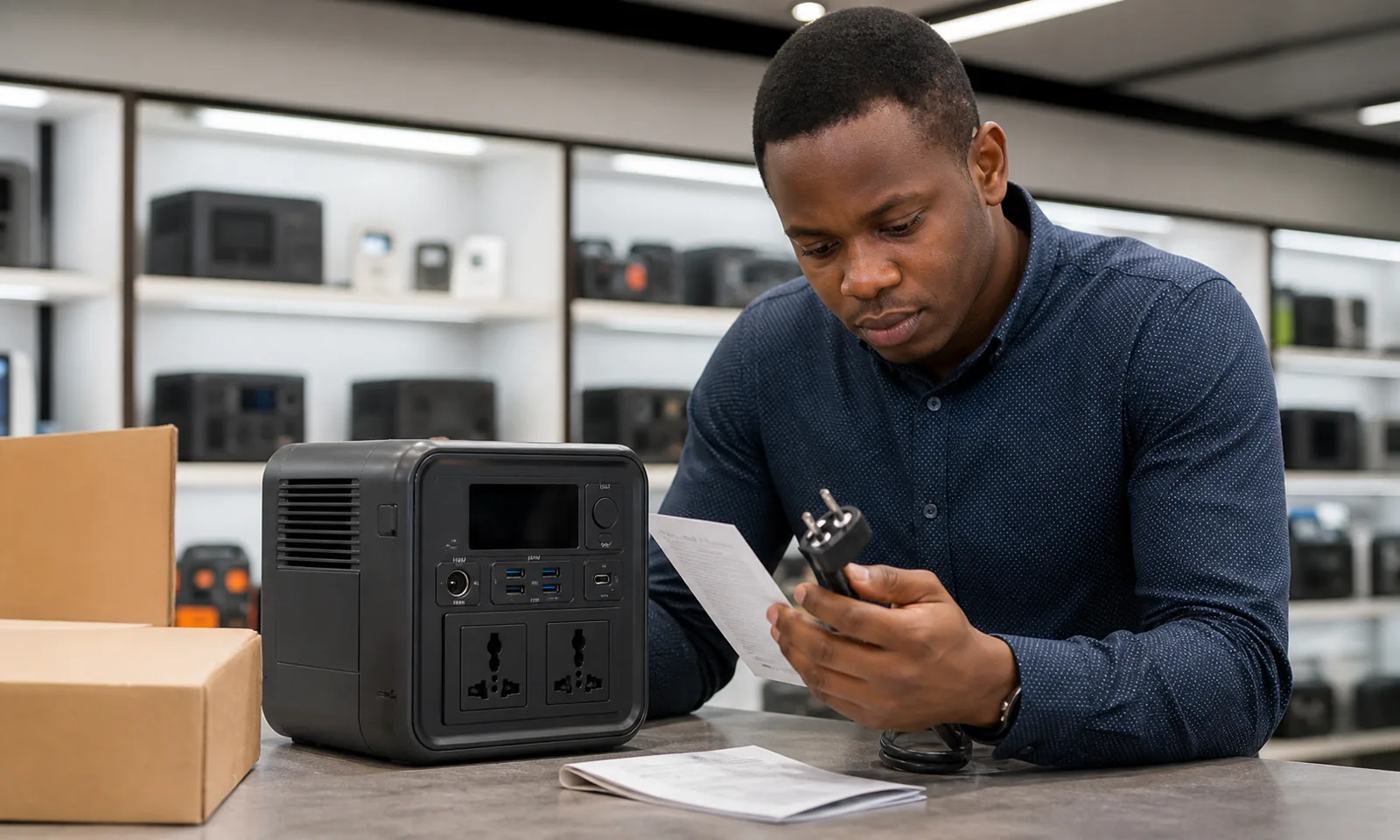
An EcoFlow portable power station Kenya search can produce listings with similar names but very different capabilities. “RIVER,” “DELTA,” “Max,” “Pro,” “Plus” and “extra battery” are not interchangeable labels. Capacity, AC output, regional sockets, compatible accessories and warranty arrangements can change by exact model and market version.
The safest approach is to copy the full model number from the product label, then compare it with the manufacturer's current manual. Do this before discussing discounts or delivery. A title and product photo alone do not establish that the item has the right outlets, can power your load or has a practical service route in Kenya.
First identify what the listing actually contains
An EcoFlow power station and an EcoFlow extra battery perform different jobs.
| Item | What it normally provides | Essential buyer check |
|---|---|---|
| Portable power station | Battery, control electronics and outputs such as AC, USB or DC, depending on model | Confirm capacity, continuous output, sockets, input and regional version |
| Smart extra battery | Additional stored energy for specified compatible equipment | Confirm the exact main power station and cable required |
| Solar panel | A charging source within specified voltage and current limits | Confirm connector, electrical limits and whether cables are included |
| Accessory or cable | A connection for a defined model or charging method | Match the part number and intended direction of use |
An extra battery is not automatically a stand-alone power station. EcoFlow's DELTA 3 Smart Extra Battery manual instructs the user to connect it to the extra-battery port of a compatible EcoFlow power station, and provides a model compatibility table. Some extra batteries may also work with specified EcoFlow ecosystem equipment, but that must be confirmed from the exact manual.
Do not infer compatibility from a plug that appears to fit. Similar-looking units can use different protocols, cables or firmware. A listing for “EcoFlow battery 1kWh” should be clarified in writing: is it a complete power station, a smart extra battery, or another ecosystem battery designed for installation in a larger system?
Use model families only as a starting point
EcoFlow's current global power-solutions page groups smaller RIVER models separately from larger DELTA models. At the time of writing, the page gives examples including:
- RIVER 3 at 245Wh capacity and 300W output;
- RIVER 3 Plus at 286Wh and 600W;
- RIVER 2 Pro at 768Wh and 800W;
- DELTA 3 Classic at 1,024Wh and 1,800W;
- DELTA 3 Max Plus at 2,048Wh and 3,000W; and
- DELTA 3 Ultra Plus at 3,072Wh and 3,600W.
These figures are useful for understanding the range, not for identifying a unit from its appearance. Models and regional versions can change, and a seller's listing may concern an older or different product. Check the nameplate, full manual and contents for the exact item offered.
Capacity in watt-hours helps estimate energy available. Output in watts determines whether simultaneous loads fit within the unit's limit. Neither number alone tells you the runtime. Build a device list, calculate watts multiplied by hours, account for conversion losses and reserve, and check startup demand for refrigerators, pumps or other motor loads.
Require a Kenya-compatible electrical version
Regional compatibility is more than the shape of the socket. Before paying, ask for a clear photograph of the product nameplate and the actual AC outlets. Compare the following with the official manual:
- AC output voltage and frequency;
- continuous and surge output;
- AC input range;
- socket format and supplied charging cable;
- USB and DC output limits;
- model number and regional suffix; and
- certification or conformity markings shown on the unit.
The intended Kenyan use must be supported by the unit's electrical specifications and connections. A travel adapter only changes how plug pins connect. It does not convert voltage, increase current capacity or make a foreign-market version suitable. Avoid improvised socket conversions, altered charging leads and unqualified rewiring.
If a seller describes a product as “UK,” “EU,” “US,” “AU,” “ZA” or “global,” ask for the corresponding manual and nameplate rather than interpreting the label yourself. Confirm that the supplied plug and output sockets are appropriate for the devices you intend to connect in Kenya. Where installation or changeover wiring is proposed, use a qualified professional and obtain a written scope.
Check ports and charging methods against your use
Two units with similar capacity can feel very different in daily use. Count the AC outlets needed at the same time, but also review USB-C Power Delivery, USB-A, DC outlets and any shared-output limits. Direct USB-C charging may avoid an AC charger for a compatible laptop, although both the port and cable must support the required wattage.
For solar charging, never buy a panel on connector shape alone. Compare the panel's open-circuit voltage, operating current and maximum power with the power station's solar-input limits. Confirm whether the correct cable is included and whether panels will be connected in series or parallel. Incorrect voltage or polarity can damage equipment or create a safety hazard.
For AC charging, ask how long the exact model takes under the supported input setting and whether high-speed charging changes fan noise or power demand. Do not connect an extension, inverter or generator unless the relevant manuals permit the arrangement.
Treat chemistry and cycle-life claims carefully
Many current EcoFlow models use lithium iron phosphate, often written LFP or LiFePO4, but this should not be assumed for every historic or second-hand unit. Check the exact specifications. Cycle-life statements normally describe capacity remaining after a stated number of cycles under defined conditions; they do not promise that every battery will deliver that calendar life.
For a used unit, request:
- serial and model-number photographs;
- original proof of purchase where available;
- a demonstration of charging and outputs under a safe load;
- disclosure of repairs, liquid exposure, drops or overheating;
- battery state or cycle information available in the official interface; and
- all included cables, covers and manuals.
Reject a battery with swelling, a cracked case, burnt connectors, abnormal smell, repeated error messages or evidence of unauthorized opening. Do not ask a seller to bypass protection settings merely to complete a demonstration.
Verify the warranty route before relying on it
“Manufacturer warranty” is incomplete unless the responsible party, territory, duration, proof requirements and service location are written down. EcoFlow's global after-sales policy says warranty and cross-regional service depend on factors including purchase channel, product, original region and supported service country. The policy also states that EcoFlow does not provide a blanket global warranty and that some cross-regional work can involve charges or may be unavailable.
Kenya is not listed on that policy page among the countries supporting the described limited international warranty programme. Therefore, do not assume an imported unit can be sent to any EcoFlow service centre at no cost. Ask the relevant seller:
- Who receives a fault report in Kenya?
- Is the warranty the seller's, an importer’s or the manufacturer's?
- What document starts the warranty period?
- Where is diagnosis or repair performed?
- Who pays transport, duties or replacement costs?
- What exclusions apply to the battery and accessories?
Keep the listing, invoice, serial number and written terms. Kenya's Consumer Protection Act contains rules relevant to consumer representations and internet agreements, but resolving a dispute is still harder when the exact product and contracting seller were never documented.
Final EcoFlow buyer checklist
Before confirming an order, verify:
- complete product name and model number;
- power station versus extra battery status;
- nominal Wh capacity and continuous W output;
- supported startup or surge requirement for your loads;
- Kenya-compatible input, plug and output sockets;
- exact extra-battery and solar compatibility;
- included cables and accessories;
- condition, serial number and proof of purchase;
- written warranty provider and Kenya service route;
- final price and payment recipient;
- delivery or pickup method; and
- return process if the model or condition differs from the agreement.
Use JAAT buyer tips and the platform's refunds and returns information to prepare your questions. JAAT can help you discover and compare listings, but it does not turn a listing into proof of regional compatibility, authorization or manufacturer warranty.
Compare carefully on JAAT
Use this EcoFlow portable power station Kenya checklist while browsing relevant options through JAAT electronics and electronics category listings, then contact the named seller. Confirm current stock, final price, exact regional model, plug and voltage, warranty responsibility, delivery and payment terms before paying. The strongest EcoFlow purchase is the one whose identity, load fit and after-sales route are all clear in writing.