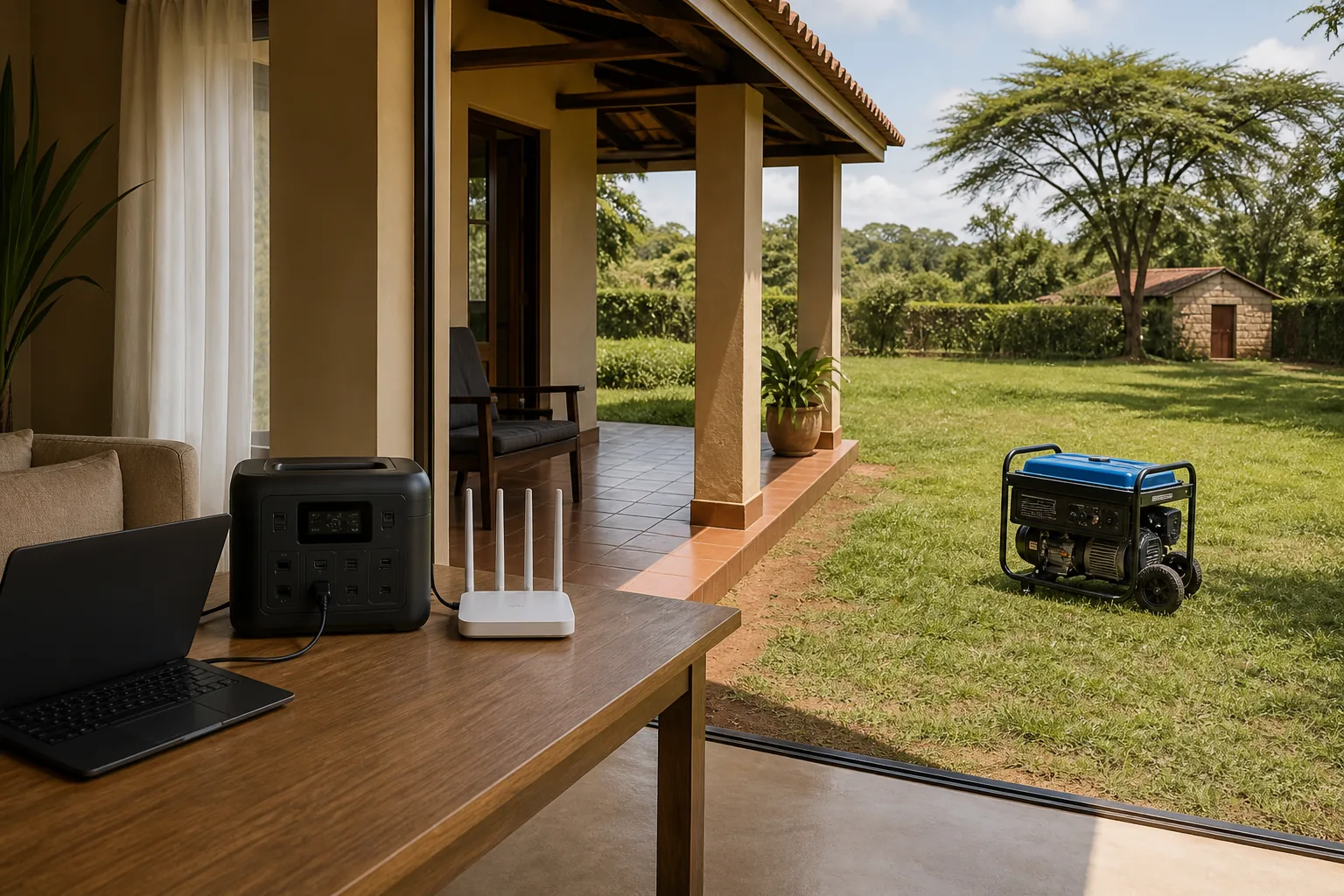
A portable power station vs generator Kenya comparison should define the load, operating location and required hours first. A battery station is usually convenient for electronics and indoor use when operated according to its manual. A fuel generator can support longer or heavier work if it is correctly sized, maintained and operated safely outdoors. Neither option is automatically best.
This decision affects more than purchase price. Consider exhaust, noise, refuelling, charging time, startup power, weather protection, storage and who will operate the equipment. A backup source that cannot be used safely at the property is not a practical bargain.
The basic difference
A portable power station stores electrical energy in a rechargeable battery and provides outputs through built-in electronics. It must be recharged from a supported source such as AC, solar or a vehicle connection, depending on the model.
A portable generator converts fuel energy into electricity while its engine runs. It needs the correct fuel, oil and maintenance, and produces exhaust gases, heat and noise. Fuel can extend runtime when safely stored and available, while a battery station must recharge once its stored energy is depleted.
| Question | Portable power station | Fuel generator |
|---|---|---|
| Energy available | Limited by battery capacity and recharge access | Limited by fuel supply and rated operating conditions |
| Point-of-use exhaust | No combustion exhaust from the unit | Produces exhaust including carbon monoxide |
| Noise | Usually fan and electronics noise under load | Engine and exhaust noise while running |
| Maintenance | Follow battery, firmware, ventilation and storage instructions | Engine oil, fuel, filters, starting system and service schedule |
| High-load ability | Depends on inverter's continuous and surge ratings | Depends on generator's rated and starting output |
| Indoor operation | Follow the power-station manual and keep ventilation clear | Never operate a portable fuel generator indoors or in an attached space |
Safety creates the first dividing line
Portable generators produce carbon monoxide, an odourless and colourless poison. The US Centers for Disease Control and Prevention warns on its generator safety fact sheet that portable backup generators can kill without warning. A generator must not be run inside a home, shop, garage, corridor or other enclosed or partly enclosed area, even if doors or windows are open.
Locate and operate a generator strictly according to its manual and applicable safety guidance, away from doors, windows and vents. Protect it from unsafe wet conditions without creating an enclosure that traps exhaust or heat. Never back-feed a building through a wall socket. If connection to fixed wiring is required, use a qualified electrician and appropriate transfer equipment.
A battery station avoids combustion exhaust at the point of use, but it is not risk-free. Rechargeable high-energy batteries can overheat or burn if defective, damaged or misused. The US Consumer Product Safety Commission lists standards addressing portable power packs and high-energy battery hazards on its battery safety programme page. Use the supplied or approved charger, keep ventilation openings clear, respect temperature limits and stop using a unit that swells, smells abnormal, has liquid damage or repeatedly overheats.
Compare output before runtime
Begin with the devices that must operate simultaneously. Add their running watts, then identify any startup surge from refrigerators, pumps, compressors or tools. The backup source's continuous output must support the running load, while its surge capability must cover applicable startup demand within the manufacturer's limits.
Do not confuse these figures:
- watts describe the rate of power being supplied or consumed;
- watt-hours describe nominal stored battery energy;
- rated generator output is the continuous power stated by its maker; and
- maximum or starting output is normally available only for a limited condition or period.
Marketing features that allow a battery inverter to operate selected appliances above its ordinary output are not identical to continuous native output. Likewise, a generator's maximum rating should not be treated as its all-day rating. Use the exact manual, not a rounded listing title.
Estimate battery runtime honestly
For a first estimate, multiply each device's watts by the hours required and add the results. A 10W router running for eight hours represents 80Wh of load energy. A 50W laptop load for four hours represents 200Wh. Together, the arithmetic requirement is 280Wh before conversion losses, changing demand and reserve.
Do not divide nominal battery capacity by load and publish the result as a promise. AC inverter losses, standby consumption, temperature, battery condition and load behaviour affect usable runtime. Manufacturer examples can help only when their test load matches yours. EcoFlow's DELTA 2 page, for example, states a 1kWh nominal capacity and gives device examples under specified assumptions; it does not guarantee the same result for every appliance.
If the station will be recharged by solar, compare realistic daylight and panel conditions with the exact solar input limits. If recharge must come from the grid, decide whether the outage pattern leaves enough time between events.
Estimate generator runtime and fuel requirements
Generator runtime depends on tank size, fuel type, load, engine condition and the maker's test assumptions. A quoted “hours per tank” figure is meaningful only when the load percentage and tank volume are stated. Ask for the manual's fuel-consumption or runtime table rather than accepting an unqualified number.
Budget for fuel, oil, routine service, safe storage and eventual parts—not just the machine. Old fuel can create starting and maintenance problems. Refuel only after shutdown and cooling as instructed. Store fuel in approved containers and follow local fire and building requirements.
For an occasional router-and-laptop outage, a generator may involve more operating work than the load justifies. For extended work with tools or repeated high loads, a suitably rated generator may be more practical than attempting to buy enough portable battery capacity. The actual answer comes from the duty cycle.
Noise and neighbourhood fit matter
Battery stations are not silent: cooling fans can become noticeable during high loads or fast charging. They are generally much quieter than an engine-driven generator, but buyers should still check acoustic information and operating modes for the exact model.
Kenya's Noise and Excessive Vibration Pollution Control Regulations prohibit loud, unreasonable, unnecessary or unusual noise and set permissible levels by zone and time. Generator ownership does not override those obligations. Consider neighbours, bedrooms, schools, clinics and mixed-use premises before purchase. A seller's “silent generator” label is not a legal or measured guarantee.
Which option fits common situations?
Router, phones, lights and a laptop
A correctly sized battery station is often simpler because these are modest loads and there is no fuel engine to start. Check USB-C output, AC socket compatibility and capacity for the required hours.
Refrigerator or medical-related continuity
Measure the load and startup demand, then build reserve. For health-critical equipment, obtain guidance from the equipment provider and do not depend on a consumer backup estimate alone. Consider alarms and a tested contingency plan.
Workshop tools or pumps
Starting current and duty cycle become central. A generator may be suitable, but only if its rated output, power quality and operating environment fit. Some sensitive electronics may also need specific power-quality characteristics.
Long outages with limited grid access
Fuel availability can favour a generator; reliable solar charging can favour a battery system. Weather, panel placement, fuel storage and maintenance determine which advantage is real at the site.
Combined system
Some manufacturers support defined combinations of batteries, solar and generators. Do not invent a connection between products. Follow compatible-model lists, approved cables and manuals. Fixed changeover or building integration needs professional design.
Buying checklist for either option
Confirm in writing:
- exact manufacturer, model and regional version;
- continuous and surge or starting output;
- battery Wh or generator fuel/runtime basis;
- voltage, frequency, sockets and power quality;
- your simultaneous load and operating hours;
- safe location, ventilation and weather requirements;
- included cables, wheels, batteries or starting accessories;
- maintenance and storage schedule;
- warranty provider, duration and service location;
- final price, delivery, payment and return terms; and
- who is responsible for any electrical installation.
Review the JAAT buyer tips, shipping and delivery information and refunds and returns information while comparing offers. These checks do not prove that any particular listing is currently available or suited to your property.
Compare backup-power options on JAAT
Use the portable power station vs generator Kenya checklist while browsing JAAT electronics listings with your load sheet in hand. Ask the relevant seller to confirm current stock, exact model, final price, warranty route, delivery and payment terms. Choose a portable power station or generator because its documented output, runtime plan and safe operating method fit—not because one technology is described as universally better.