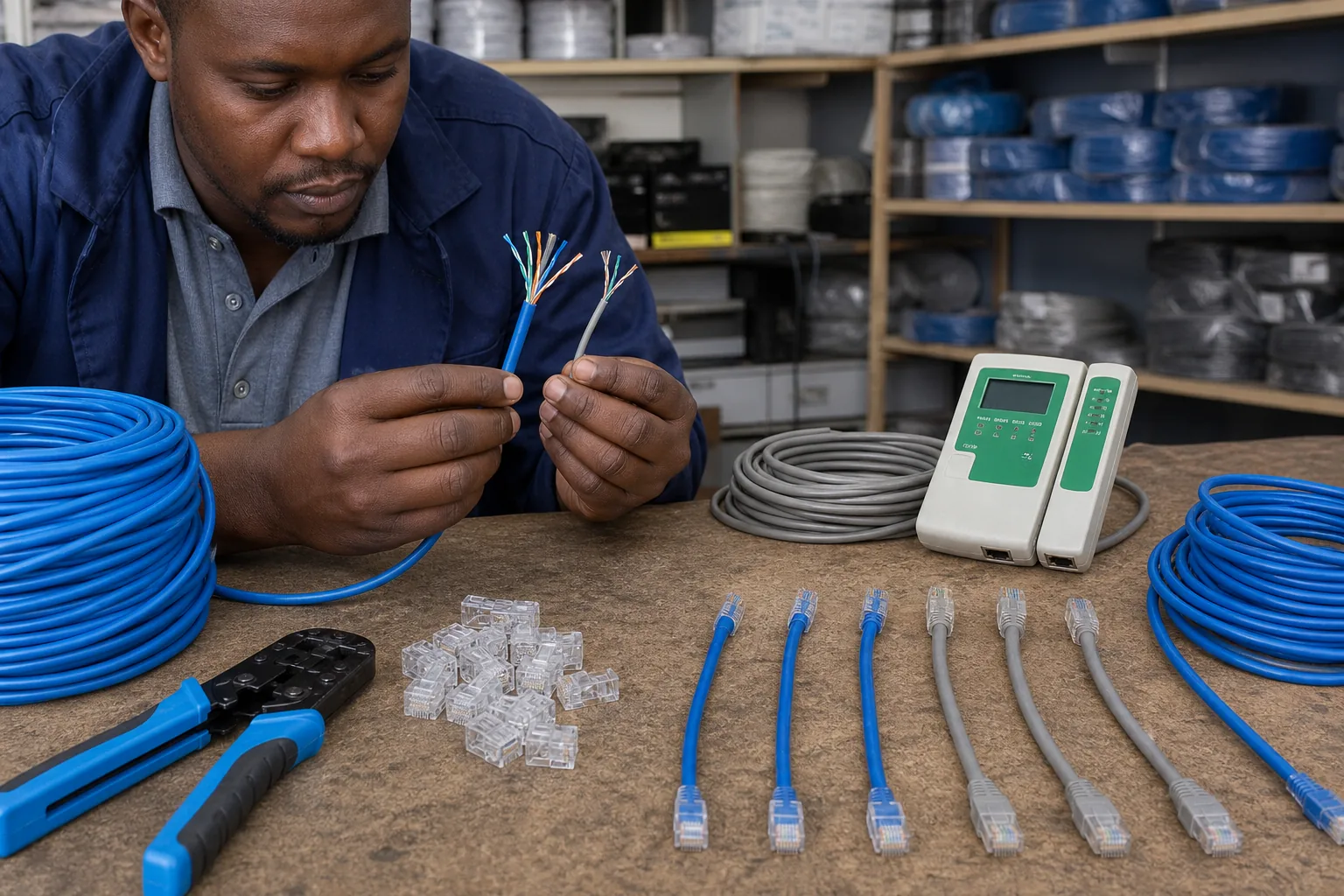
The search phrase Cat6 Ethernet cable buying guide Kenya should lead to the factors that determine a reliable wired link: required length, conductor material, cable construction, jacket, connectors, installation and test result. “Cat6” printed in a title is not by itself proof of standards compliance or a guarantee of internet speed.
Category performance applies to a complete channel. Poor plugs, excessive untwisting, sharp bends, damaged cable or mixed low-quality components can prevent a labelled Cat6 cable from delivering the expected result. Start by deciding whether you need a finished patch cord or permanent building cabling.
Patch cord or installation cable?
A patch cord is a factory-terminated flexible cable used between equipment and a wall outlet, patch panel or switch. It normally uses stranded conductors so it can flex repeatedly.
Horizontal or installation cable is normally solid-conductor cable pulled through an approved pathway and terminated on compatible jacks or patch panels. It is not intended to become a long improvised patch lead with plugs attached casually at both ends.
For a one-metre connection from a router to a switch, buy a tested finished patch cord of the correct category. For an office floor, cameras or access points, design a structured cabling channel with suitable cable, outlets, patch panels, patch cords and test documentation.
The plug or jack must match the conductor type and gauge. Some modular plugs are intended for stranded conductors, some for solid conductors, and some support both within a specified range. A plug that physically crimps is not necessarily a compliant termination.
What Cat6 performance means
Leviton's official Cat6 systems overview describes Category 6 as a copper structured-cabling standard with bandwidth up to 250MHz and support for 1Gbps over 100 metres. That statement assumes a compliant channel and suitable network equipment.
Do not confuse frequency in megahertz with data rate in megabits or gigabits per second. The 250MHz category rating describes tested transmission performance across a frequency range. A network interface negotiates an Ethernet link rate. Your internet result is then limited by the slowest relevant part of the provider service, router, switch, cable and endpoint.
A Cat6 cable does not make a 100Mbps router port run at 1Gbps. It also cannot make a one-Gigabit laptop interface transfer at 10Gbps. Check port capabilities and negotiated link status alongside the cable.
Plan length using the channel limit
For ordinary standards-based copper Ethernet design, the commonly cited 100m channel includes the fixed link and patch cords. Fluke Networks' cable length guidance explains the 90m limit for the permanent link and 100m for the complete channel.
That means you should not order 100m of fixed cable and then add patch leads without calculation. A conventional plan allows up to 90m for installed horizontal cable and a combined patch-cord allowance within the 100m channel design. High temperature, bundling, conductor gauge and Power over Ethernet can require additional engineering limits.
Measure the pathway, not the straight-line distance. Include vertical rises, bends, service loops, cabinet routing and termination points, but do not leave large uncontrolled coils. For a run approaching the limit, use a qualified installer and certification tester. For a building or gate beyond the supported copper distance, compare fibre or a properly designed network extension instead of hoping that extra cable will work.
Cat6 does not equal full-length 10 Gigabit Ethernet
Cat6 is a strong choice for Gigabit Ethernet, but buyers should be careful with “10Gbps Cat6” claims. CommScope's current Cat6A technical comparison shows Cat6 at 250MHz with 1G support to 100m and limited 10G distance, while Cat6A is specified at 500MHz and supports 10G to 100m in the stated comparison.
If a new office needs 10GBASE-T across ordinary full-length channels, specify a complete Cat6A design rather than assuming Cat6 will provide it. For a short known link, check the Ethernet equipment requirements and applicable standards, then certify the installed channel.
Marketing phrases such as “up to 10Gbps” often omit distance, channel construction and test conditions. Request the cable datasheet and the application distance in writing.
Read the conductor material markings
The word “copper” can be used loosely in marketplace descriptions. Inspect the manufacturer's datasheet, reel label and repeated jacket legend for the actual conductor construction.
Common descriptions include:
- solid bare copper;
- stranded bare copper;
- copper-clad aluminium, often abbreviated CCA;
- aluminium or copper-clad markings; and
- conductor gauge expressed as AWG or millimetres.
UL Solutions' wire and cable application guide explains that aluminium and copper-clad aluminium products should carry material-identification markings such as “AL,” “ALUMINUM” or “COPPER-CLAD ALUMINUM,” depending on the product category. Use documented markings and certification information rather than a magnet, colour scrape or seller assurance as the only test.
For standards-based data cabling, especially Power over Ethernet, specify the conductor material required by the system design and verify that the complete cable is listed or certified for that application. Copper-clad aluminium has different resistance and installation characteristics from solid copper and should not be silently substituted.
Solid versus stranded conductors
Solid conductors are normally preferred for permanent horizontal runs because they have lower attenuation than an equivalent stranded construction and terminate on structured-cabling hardware. Stranded conductors are more flexible and are normally used in patch cords.
Do not choose only by “23AWG is better than 24AWG.” Gauge, conductor material, insulation, twist geometry, jacket, connector compatibility and verified performance all matter. A thick non-compliant cable does not become Cat6 because its conductor appears large.
Patch-cord length allowances can differ when cords use smaller or higher-loss conductors. Follow the system manufacturer's channel rules rather than mixing arbitrary bulk cable and plugs.
UTP, shielded cable and grounding
Unshielded Cat6, often marked U/UTP, is common in homes and offices. Shielded constructions can improve noise control in an engineered environment, but the cable, jacks, patch panels, cords and bonding approach must work as a system.
Do not buy shielded cable simply because it sounds premium. An incorrectly terminated shield can add cost without delivering the intended performance. Ask a competent installer to assess routes near electrical equipment, cable separation, earthing and local electrical requirements.
Regardless of shielding, maintain pair twists close to the termination, respect bend radius and pulling tension, and avoid crushing the jacket with tight clips. Keep data cabling in suitable pathways and separated from mains power as required by applicable rules.
Choose the correct jacket and environment
Indoor PVC cable is not automatically suitable outdoors, underground or in air-handling spaces. Check the exact jacket rating and intended installation environment.
For outdoor runs, assess ultraviolet exposure, moisture, lightning risk and entry into buildings. “Outdoor” does not necessarily mean direct-burial. A direct-burial cable may need water-blocking construction and appropriate pathway. Links between buildings can introduce electrical-potential and surge risks; fibre is often considered because it does not carry electrical current between endpoints.
For ceilings, risers or escape routes, the required flame and smoke classification depends on the building design and applicable code. Do not conceal an unmarked cable in a wall simply because it passes data on a bench.
Power over Ethernet needs extra checks
PoE can power cameras, access points and phones through the data cable. Current flows through the conductors, so resistance, bundle temperature, connector quality and channel length matter.
Confirm:
- the device's required PoE standard and power;
- the switch or injector's per-port and total budget;
- cable conductor material and gauge;
- bundle size and ambient temperature;
- connector and patch-panel suitability; and
- manufacturer guidance for the intended PoE level.
Do not use unmarked, damaged or underspecified cable for a high-power bundle. A link that passes a simple continuity test may still have excessive resistance or poor transmission performance.
Test more than continuity
A low-cost wiremap tester can reveal opens, shorts, reversals and split pairs, but it does not certify Category 6 performance. For a paid permanent installation, request a result for each labelled link from an appropriate field certification tester using the correct Cat6 permanent-link or channel limit.
The report should identify the link, test limit, length and pass/fail result. Save the electronic files with the floor plan and port labels. If a link negotiates only at 100Mbps, inspect all four pairs, terminations and ports; Gigabit Ethernet normally requires all four pairs.
Buyer checklist
Before paying, confirm:
- patch cord or permanent-installation cable;
- exact manufacturer and product code;
- genuine Cat6 datasheet and relevant certification;
- solid or stranded conductor;
- conductor material and gauge;
- U/UTP or specified shielded construction;
- metre length and channel design;
- indoor, outdoor, direct-burial or required fire rating;
- connector compatibility;
- PoE requirements;
- test method and report for installed links; and
- final price, delivery, payment, warranty and return terms.
Use the JAAT buyer tips, shipping and delivery information and refunds and returns guidance to document the transaction. If installation is included, separate the cable product, labour, containment, terminations and certification in the quote.
Compare Cat6 cable on JAAT
Use this Cat6 Ethernet cable buying guide Kenya checklist while browsing the JAAT internet and networking category after deciding the construction, route and length you need. Ask the relevant seller to confirm current stock, exact product code, conductor material, metre count, final price, warranty responsibility, delivery and payment terms. A cable selected from documented specifications and verified by testing is more valuable than an inexpensive reel carrying only a Cat6 label.