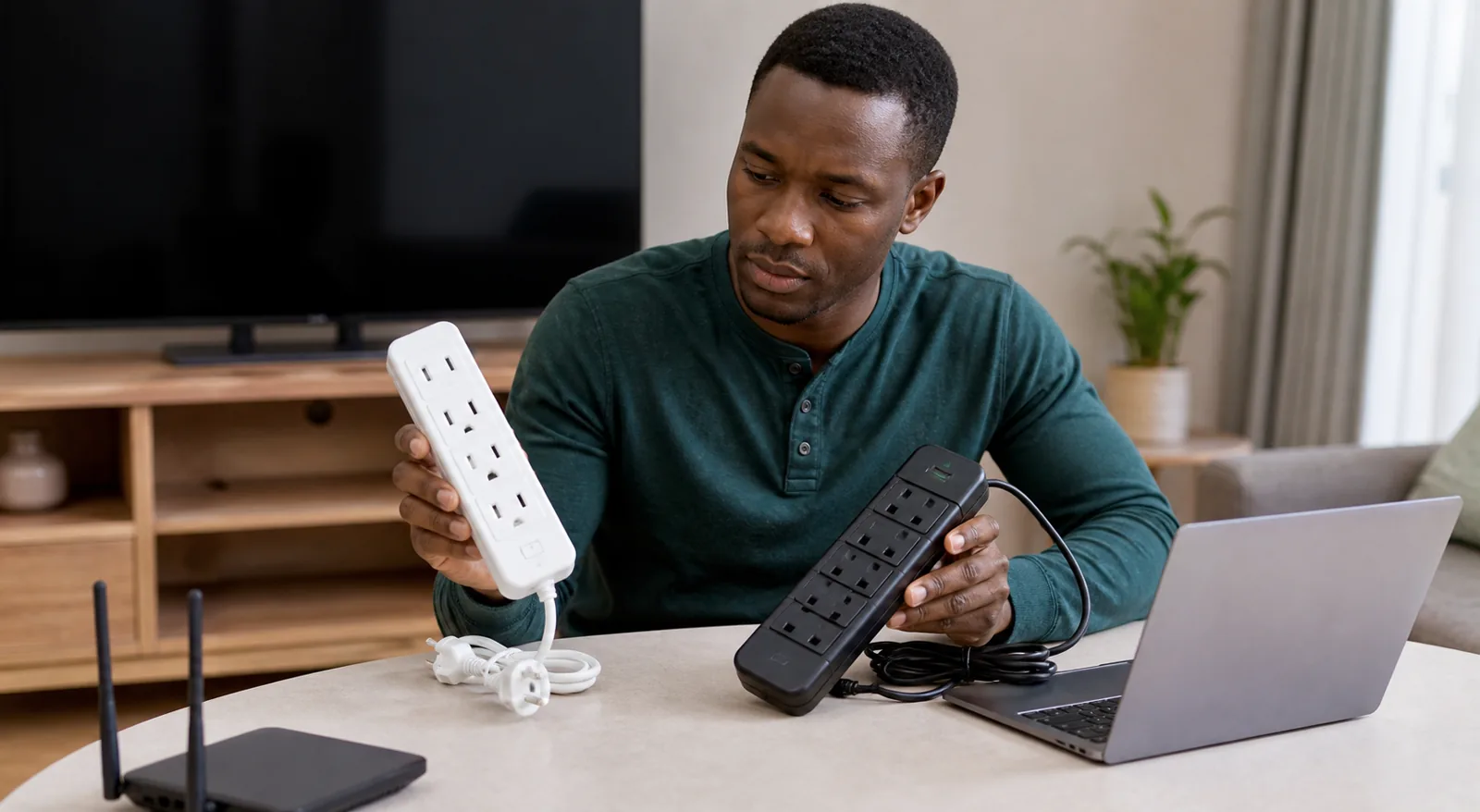
The practical difference in a surge protector vs extension socket Kenya comparison is not the number of outlets or the shape of the casing. An extension socket extends power to more convenient connection points. A surge protector includes a protective function intended to limit short-duration voltage surges before they reach connected equipment. Some products combine both functions, but many ordinary multi-socket strips provide no surge protection at all.
That distinction matters when connecting a television, router, desktop computer, game console or other valuable electronics. A strip labelled only with its cable length, outlet count and current rating should not be treated as a surge protective device. Equally, a surge protector does not make an overloaded outlet safe, correct poor building wiring or keep equipment running during an outage.
Use this guide to compare listings in electronics and accessories, then confirm every important specification on the product label, manual or manufacturer's page before buying.
What an extension socket actually does
An extension socket, extension lead or basic power strip carries electricity from one wall outlet to one or more sockets at another position. Its useful specifications include the rated voltage and current, plug and socket type, cable length, conductor size, earthing arrangement, shutter design and whether the product is intended for indoor or outdoor use.
The current edition of IEC 60884-2-7 covers cord extension sets for household and similar purposes and defines electrical and mechanical safety requirements. That does not mean every product advertised online complies with it. It gives buyers a reason to look beyond appearance and ask for a clear model number, legible ratings and credible conformity information.
A basic extension socket may include a switch, overload breaker or USB charging ports. None of those features automatically means it has surge protection. A switch controls the supply. An overload device may interrupt excessive current under its designed conditions. USB ports convert power for compatible devices. Surge protection is a separate claim that needs separate evidence.
What a surge protector is designed to do
A surge protective device, or SPD, responds to transient overvoltage: a brief spike that can arise from switching events, faults or lightning-related electrical activity. IEC 61643-11:2025 sets requirements and test methods for low-voltage AC surge protective devices, describing products intended to limit surge voltage and divert surge current.
Point-of-use surge strips often resemble ordinary extension sockets. The important difference is the protective circuitry and its tested ratings—not a red switch or the word “power.” The Electrical Safety Foundation International also warns that not every power strip is a surge protector and that surge protection does not give a circuit additional capacity.
Surge protection reduces a particular risk; it is not absolute protection. No small plug-in strip can promise immunity from every event, especially a direct lightning strike. Protection can also degrade after repeated or severe surges. If an indicator shows that protection has failed, or the manufacturer says replacement is required after a major event or stated service condition, stop relying on it.
Do not confuse four different jobs
Buyers often use “protector” for several devices that solve different problems:
- Extension socket: adds reach or outlets, subject to its electrical rating.
- Surge protector: limits specified transient overvoltage under defined test conditions.
- Voltage regulator or AVR: attempts to correct longer changes in supply voltage within its operating range.
- UPS: supplies temporary battery power and may include voltage or surge functions stated by its manufacturer.
A circuit breaker or fuse deals mainly with excessive current; a residual-current device helps protect against certain electric-shock faults. Neither should be casually described as a substitute for all the others. The right setup may involve several coordinated protections, particularly in a home office or business with expensive equipment.
If lights fluctuate, plugs heat up, breakers trip repeatedly or shocks are felt from equipment, do not solve the symptom by buying a bigger strip. Disconnect the affected load safely and use a qualified electrical worker to investigate the installation.
Compare the label, not the outlet count
When assessing a surge protector listing, ask the seller for photographs of the product label and packaging. Compare at least these points:
- Exact model and manufacturer. A traceable model lets you find the correct manual and reduces confusion between visually similar versions.
- Supply and load rating. The rated voltage, frequency and current must suit the installation and connected load. Never infer capacity from cable thickness or case size.
- Surge-performance information. Depending on the product, the maker may state a voltage-protection level, maximum discharge current, joule rating or other tested values. Compare like with like and ask which standard supports the claim.
- Protection-status indication. A light marked “protected” is different from a simple power-on light. Read the manual to understand what each indicator means.
- Earthing requirements. Many protectors depend on a correctly wired protective-earth path. A three-pin shape alone does not prove the building socket is correctly earthed.
- Warranty terms. Look for the actual product warranty, exclusions and claim process. A large “connected equipment guarantee” is useful only if its written terms are available and applicable in Kenya.
Do not choose solely by the largest joule number. Ratings, test method, protection modes, construction quality and installation all matter. A vague listing that says “anti-lightning” but supplies no model, rating or instructions gives the buyer little to verify.
Calculate the load before plugging in
An extension with several sockets makes it physically possible to connect many appliances, but it does not increase the safe capacity of the wall circuit. Add the input power or current of devices that may operate at the same time and keep within the lowest applicable limit: the strip, plug, wall outlet, circuit and manufacturer instructions.
High-power heating and motor loads deserve particular care. Kettles, irons, room heaters, microwaves, refrigerators and pumps can draw substantial current or have high starting demand. Do not connect them to a general electronics strip unless the exact product and appliance instructions permit that use and the circuit is suitable.
Never plug one extension strip into another to create a chain. Do not hide a coiled or loaded cable under a rug, pinch it in a door, or continue using a cracked plug, loose socket, exposed conductor or heat-discoloured casing. EPRA's electrical-safety guidance tells consumers not to overload sockets, to avoid damaged cords and to use certified electricians for electrical work.
Choose protection for the actual risk
For a router and laptop charger, a reputable point-of-use protector may be a reasonable final layer. A television, decoder and game console can share a protector only when their combined load and the product instructions allow it. Network, antenna or data cables can also provide paths for transients, so protecting only the mains lead may leave another exposure.
For a building with frequent disturbance, solar equipment, sensitive business systems or a lightning-prone installation, ask an electrical professional about coordinated protection at the distribution board and at equipment. The design must consider earthing, conductor routing, upstream protection and the equipment being protected. Do not attempt distribution-board work from an online tutorial.
A surge protector also cannot provide backup power. If the goal is to keep a router online or shut down a computer safely, compare an appropriately specified UPS or DC backup solution. Read JAAT buyer tips before agreeing to a listing whose wording combines surge protection, voltage regulation and battery backup without separate specifications.
Inspect before first use and during ownership
When the item arrives, check that its model and ratings match the listing. Inspect the plug, cable, case and sockets for transport damage. The plug should fit correctly without force, and connected plugs should not sit loose. Keep the strip dry, uncovered and where damage or unusual heat can be noticed.
During use, treat buzzing, burning smell, sparking, melting, repeated tripping or abnormal heat as stop signals. Switch off and disconnect safely; do not open or repair a sealed mains product unless qualified and authorised to do so. Follow the maker's replacement instructions, especially after an indicated loss of protection.
Keep the invoice, listing screenshots, model label and seller conversation. If the received item lacks an advertised feature or arrives faulty, those records help you use the stated returns and refunds process. The outcome still depends on the seller, order route and applicable terms.
A five-question buying decision
Before paying, ask:
- Is this an extension only, or a surge protector with identifiable test ratings?
- Does its supply, plug and load rating match my installation and devices?
- What does each status light mean, and how will I know protection is exhausted?
- Is the manufacturer, model, warranty and instruction manual traceable?
- Do I need an electrician, a UPS, a voltage regulator or building-level SPD instead?
The safest surge protector vs extension socket Kenya decision starts with the job. Buy an extension for reach and outlet convenience; buy a genuine surge protector for specified transient protection; and never ask either product to compensate for overloaded, damaged or incorrectly wired circuits.
Browse relevant JAAT listings, compare the evidence behind each claim, review why buyers should verify listing details, and ask the seller for the exact model and ratings before ordering.