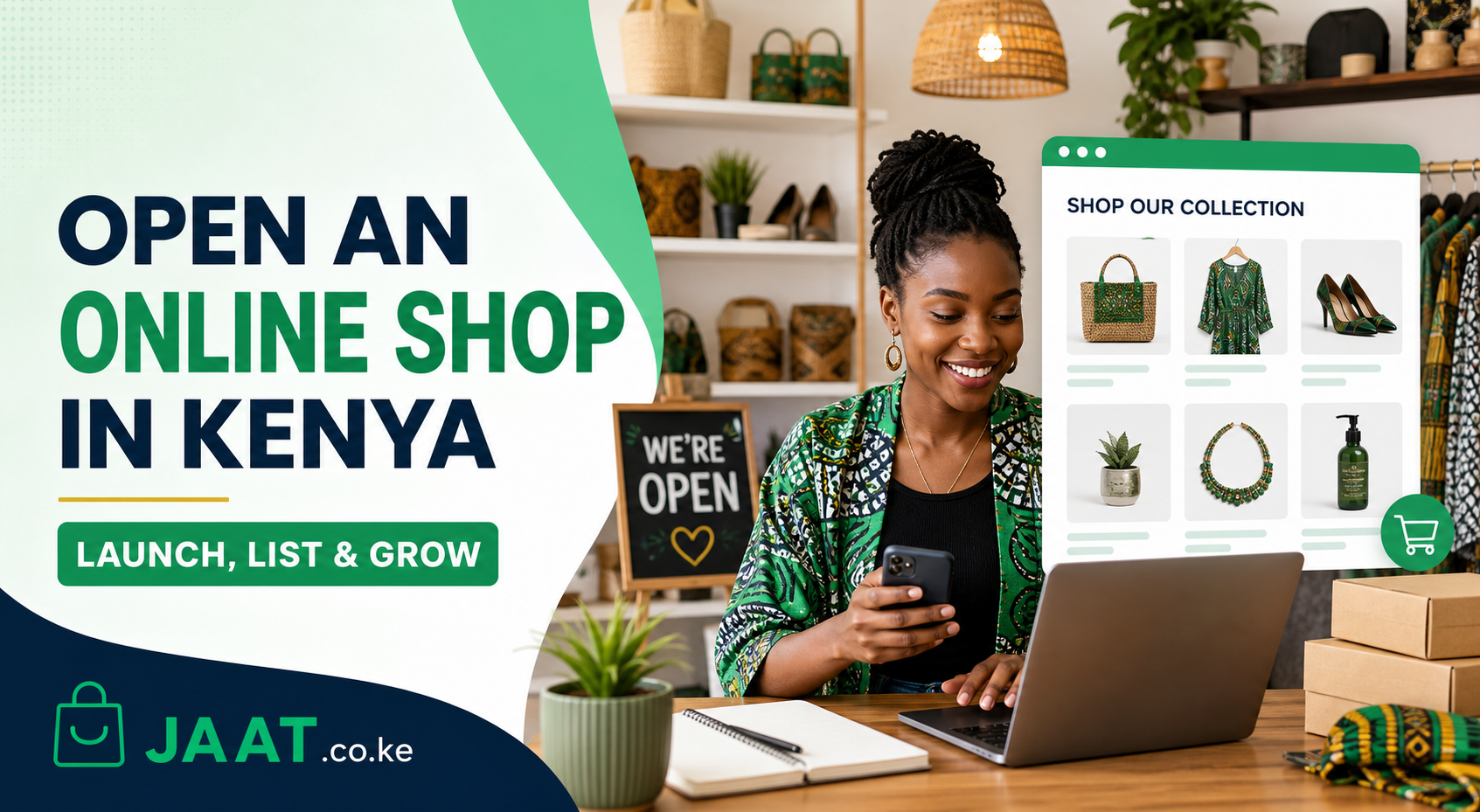
To open an online shop in Kenya, you need more than a logo, social media account or collection of product photographs. A shop is a connected customer journey: someone discovers the business, understands the offer, chooses a product, agrees to the transaction, receives the item and knows where to turn if something goes wrong. The technology is important, but it is only one part of that journey.
A Kenyan online shop can begin as a marketplace storefront, independent ecommerce website, direct-order catalogue or hybrid. The right model depends on the customer, product range, budget, technical capacity and fulfilment operation.
This guide helps you make those choices deliberately. It covers positioning, channel selection, brand foundations, catalogue design, business processes, launch preparation and sustainable growth. It does not promise overnight income or treat every platform feature as identical. Payment, delivery and customer-support arrangements vary, so your shop must explain the transaction mode that actually applies. Customers should check seller details and transaction terms before ordering.
Table of contents
- Define your shop concept and customer
- Choose the right online-shop model
- Build the brand and business foundations
- Plan the catalogue and customer journey
- Set up payments, delivery and service
- Prepare and launch the shop
- Market and grow responsibly
- A 90-day launch roadmap
- Frequently asked questions
Step 1: Define a shop concept customers can understand
Write a one-sentence positioning statement
Before selecting a platform or colour palette, explain the shop in one sentence:
We help [specific customer] find [specific product category] for [important use or outcome] through [relevant advantage].
Examples might include:
- “We help new renters in Nairobi find space-saving home essentials with clear measurements and planned local delivery.”
- “We help Kenyan home bakers source practical decorating tools and packaging in small-business-friendly quantities.”
- “We help schools and offices reorder durable cleaning supplies through organised product bundles.”
These are positioning examples, not claims that any market is guaranteed. A clear sentence guides the catalogue, tone, photography and promotion. “We sell everything at the best price” gives a new shop no believable identity.
Choose a customer narrow enough to serve
You can sell nationally later, but a launch needs a customer you can picture. Define:
- where they live or work;
- the problem they need to solve;
- how frequently they buy;
- the information they compare;
- an affordable price range for the category;
- where they currently shop;
- their delivery or collection expectations;
- the objections that delay a purchase.
Use interviews and observation, not assumptions alone. Speak with potential customers about their most recent purchase in the category. What did they choose? What was confusing? Which cost surprised them? What would make reordering easier?
Select a coherent product promise
An online shop for a small business in Kenya does not need every possible item. It needs a range that makes sense together. You might specialise by use case, customer, style, price level, location or expertise.
A coherent range makes navigation easier and creates natural bundles. Someone buying baking boxes may also need cake boards and labels. Someone buying an office chair may need a footrest or desk organiser. Random additions consume stock capital and dilute the shop's identity.
Define what makes the experience useful
Your advantage must be something you can operationally deliver. Possibilities include:
- unusually clear specifications and fit guidance;
- carefully selected products for a defined use;
- convenient collection in a particular town;
- dependable ordering for repeat business;
- made-to-order expertise;
- accessible small quantities;
- product education in plain language.
Avoid unsupported “number one,” “most trusted” or “cheapest in Kenya” claims. Specific usefulness is more convincing than a superlative with no evidence.
Step 2: Choose how the online shop will operate
Option 1: A marketplace storefront
A marketplace shop places your listings within a platform where customers already browse categories or search products. It can reduce the work required to build product-page structure from scratch and may help a new business become discoverable.
Consider:
- whether your category is supported;
- the information each listing can show;
- shop profile and seller-brand options;
- current fees or commissions;
- communication tools;
- the payment and transaction modes available;
- delivery responsibilities;
- platform rules and prohibited items;
- access to performance information.
A marketplace is not a licence to become passive. You remain responsible for accurate product information, stock, communication and any fulfilment obligations allocated to you. Do not claim that every marketplace listing is verified or protected unless the specific current process states that clearly.
Option 2: An independent ecommerce website
An independent store offers greater control over design, customer journey, analytics and content. It can support detailed categories and an owned brand destination. It also requires more work: hosting, security, checkout configuration, product data, maintenance, search visibility, legal pages and customer acquisition.
Owning a website does not automatically produce visitors or trust. Budget for ongoing management, not only the initial build. Ensure someone can update stock, software, prices and policies after the developer finishes.
Option 3: Catalogue and direct ordering
A catalogue with a stated message, phone or form process can suit custom or variable products. Use product codes, written order summaries and clear payment instructions so customers know whether a conversation has created a confirmed order.
Option 4: A hybrid shop
A hybrid can combine marketplace discovery, an independent brand website and organised support. Select one source of truth for product names, prices, stock and terms, then update every active channel when something changes.
How to choose among the options
Score each model from one to five for:
- access to your target customer;
- setup cost;
- monthly operating effort;
- catalogue fit;
- transaction clarity;
- brand control;
- data and measurement;
- maintenance capability;
- fulfilment integration;
- ability to test without excessive risk.
The highest score is not always the final answer, but the comparison makes trade-offs visible. A marketplace storefront is often a practical starting point when discovery and simple listing structure matter. An independent store may become more valuable as the brand, catalogue and repeat-customer base mature.
Step 3: Establish the business and compliance foundation
Choose the operating structure responsibly
How you register and operate depends on ownership, scale, partners, liability and future plans. Regular commercial activity may create registration, tax, consumer-protection and record-keeping obligations. Certain products and services require sector-specific licences, standards or professional qualifications.
Because requirements can change and vary by category, obtain current guidance from the relevant Kenyan authorities or a qualified professional. Do not rely on a generic blog article as legal or tax advice. Build compliance costs into the business plan instead of treating them as an afterthought.
Select a shop name
A useful name is distinctive, pronounceable and broad enough for reasonable growth without being meaningless. Search online, marketplace results, social platforms and relevant registration systems for conflicts. Check whether a suitable domain and account names are available if you plan to use them.
Avoid names that imply official government status, a relationship with another company or an expertise you do not possess. Do not build the brand around a product trademark you do not own.
Define the visual identity
At launch, you need a small, consistent system rather than a giant brand manual:
- a readable logo or wordmark;
- two or three core colours with adequate contrast;
- one or two readable type styles;
- a repeatable product-photo approach;
- a simple flyer template;
- rules for price and promotion presentation.
Your flyer should communicate one primary message at a glance. For an online-shop launch, show a believable Kenyan shopping or small-business context, a short benefit statement and a restrained call to action. Do not cover the image with dozens of tiny products and claims.
Write the essential business information
Prepare:
- shop description;
- operating location and service area;
- opening or response hours;
- contact route;
- payment methods actually accepted;
- delivery and collection information;
- cancellation and return terms;
- warranty terms where relevant;
- privacy information;
- frequently asked questions.
Write in plain English, and use Kiswahili where it meaningfully helps your customer and you can maintain both versions accurately. Do not translate only promotional messages while leaving important terms unclear.
Step 4: Build the shop's financial model
Estimate launch costs
Create a budget based on actual quotations and your chosen model. Potential items include:
- initial stock or raw materials;
- product samples and testing;
- business registration or professional support;
- marketplace subscription or listing costs;
- website setup and maintenance;
- domain and business email;
- packaging and labels;
- photography equipment or services;
- payment processing;
- launch marketing;
- delivery setup;
- customer support tools;
- contingency.
Do not use an unsupported universal “cost to start an online shop in Kenya.” A made-to-order craft shop and an appliance retailer require radically different capital.
Separate fixed and variable costs
Fixed costs continue regardless of monthly orders, such as a basic subscription or workspace. Variable costs rise with each sale, such as packaging, payment processing and delivery subsidy. This distinction helps you calculate break-even volume and choose promotions intelligently.
Calculate product contribution
For each item, subtract direct product, transaction, packaging and fulfilment costs from the selling price. The remaining contribution must help cover fixed costs and profit. A shop can generate impressive sales revenue while losing money on each delivered order.
Plan working capital
Cash can be tied up between ordering stock and receiving customer payment. Returns, delayed deliveries and supplier minimums add pressure. Start with inventory depth that matches realistic demand and reorder lead time. Do not spend the entire budget on products while leaving nothing for packaging or fulfilment.
Decide how you will record money
Separate business and personal records where practical. Track sales, costs, outstanding orders, refunds and stock movement. Choose an accounting method appropriate for the operation and current requirements. A disciplined spreadsheet can be a starting point, but it must be updated and backed up.
Step 5: Design a catalogue customers can navigate
Create customer-centred categories
Categories should reflect how people shop. A home shop might use Kitchen Storage, Cleaning Tools and Bathroom Essentials rather than supplier department codes. Keep the number manageable at launch.
Every product should have one clear primary home. Tags and filters can describe brand, colour, size or use without duplicating the same listing across many categories.
Develop a product data template
Use consistent fields for every item:
- product name;
- internal code;
- category;
- short summary;
- detailed description;
- price and currency;
- variant prices;
- brand or maker;
- dimensions or capacity;
- material or specifications;
- condition;
- stock status;
- included items;
- care or compatibility;
- location;
- fulfilment choices;
- applicable terms;
- images and alt text.
Consistency makes the shop feel organised and makes updates faster.
Decide how variants will appear
If a shirt has several sizes at one price, a variant selector may work. If furniture sizes use different materials, lead times and prices, separate product pages or a clear quotation flow may be better. Never display the lowest variant price while featuring the most expensive version without an obvious explanation.
Plan product relationships
Identify genuine complements, alternatives and bundles. A laptop sleeve may complement a laptop; a different laptop model may be an alternative. Avoid pushing accessories that do not fit. Useful product relationships increase order value while protecting customer confidence.
Prepare category introductions
A short category guide can explain who the products suit, which specifications matter and how fulfilment works. This supports search visibility and decision-making. Do not create pages that repeat the same generic paragraph with only a city or category changed.
Step 6: Create a trustworthy customer journey
Discovery
A potential customer may arrive through Google, marketplace search, a shared link or a social post. The first page should clearly match the promise that brought them there. A promotion for storage containers should not lead to a generic homepage where the product is impossible to find.
Evaluation
The product page should answer condition, specifications, price, stock, location and fulfilment. Show seller or shop details in a consistent place. Use representative images. If an item is made to order, state lead time and customisation boundaries.
Cart, enquiry or order request
Ask only for information needed at that stage. Explain whether submission reserves stock, requests a quotation or creates a payable order. Customers should not have to guess what happens after tapping a button.
Payment
Display the payment method and recipient appropriately. Confirm total cost before the customer authorises payment. Never request a PIN, bank password or one-time code. If you operate through a marketplace, follow its current transaction instructions and explain which parts the marketplace or seller handles.
Fulfilment
Send an order confirmation with product, quantity, price, destination and expected timing. Provide legitimate delivery updates. For collection, confirm location, opening time and identification process without publishing private details unnecessarily.
After-sales service
Give customers an order reference and contact route for a genuine issue. State how quickly they should report damage, missing items or a material mismatch. Apply terms consistently and consider obligations that apply beyond your voluntary policy.
Step 7: Configure payment and transaction operations
Kenyan shops may accept mobile money, cards, bank transfers, cash on collection or platform-supported methods. Choose options based on customer needs, transaction size, cost, reconciliation and operational risk.
For every method, document:
- how the customer receives the total;
- which name or account should appear;
- how payment is confirmed independently;
- how a receipt or order status is produced;
- how refunds, where due, are authorised;
- who can access payment records;
- how daily reconciliation happens.
Do not let payment confirmations live only in one employee's personal messages. Compare orders against actual account records. Use the payment provider's official route when a message or prompt is unfamiliar.
When using a marketplace such as JAAT, check which transaction mode applies to your listing. Do not describe funds as held, guaranteed or protected unless the current feature for that specific transaction clearly does so. Buyers should also review the seller details and instructions before paying.
Step 8: Build fulfilment before launch day
Map the order workflow
Draw the journey from new order to completed delivery:
- order received;
- stock reserved;
- customer and total confirmed;
- payment confirmed where applicable;
- item picked and checked;
- item packaged;
- delivery assigned or collection prepared;
- handover recorded;
- customer issue window monitored;
- order closed and stock updated.
Assign a person or rule to each step. Even a one-person shop benefits from a checklist.
Set delivery zones and prices
Begin with zones you can quote and serve consistently. Define same-town, nearby and courier destinations according to the product. Bulky furniture, chilled food and small accessories cannot share one delivery promise.
State whether delivery is included, a fixed zone fee or quoted separately. Review pricing when transport costs change. “Free delivery” is still a business cost and should not destroy margin.
Choose packaging standards
Specify materials by product type. Include protection, sealing, labels and documentation. Test a package before launch. A visually attractive box is useless if the product moves and breaks inside it.
Plan exceptions
Decide what happens when stock is wrong, a rider is delayed, the customer is unavailable or an item is damaged before dispatch. Customers judge a shop not only by perfect orders but also by how it handles a real exception.
Step 9: Build the actual online storefront
Homepage or shop profile
State what the shop sells, whom it serves and where it operates. Feature a few important categories, not every product. Include a visible route to shop, contact and read fulfilment information.
About the seller
Explain the business plainly: its focus, location, relevant experience and operating approach. Avoid a fictional founder story or inflated claim. Use a real business image where appropriate and permitted.
Product and category pages
Publish the structured content prepared earlier. Compress images without making product details unreadable. Check mobile presentation, since many customers will browse on a phone.
Policy and help pages
Make delivery, payment, returns, privacy and frequently asked questions easy to reach before checkout or enquiry. Update dates or terms when the operation changes.
Contact routes
Offer only channels you monitor. Set response expectations. A contact form, business phone and messaging option can be useful, but five abandoned channels are worse than one dependable channel.
Step 10: Test the shop before inviting customers
Run several complete test cases:
- normal order in your primary delivery zone;
- different product variant;
- sold-out product;
- cancelled order before dispatch;
- failed or unconfirmed payment;
- customer entering an incomplete address;
- mobile enquiry;
- return or damage report according to policy.
Ask someone unfamiliar with the setup to find an item and explain the transaction. Observe where they hesitate. Do not guide them immediately; the confusion reveals what the shop needs to clarify.
Proofread prices, phone numbers, account names and policy links. Test notifications and order references. Confirm that private customer information is not displayed publicly.
Step 11: Plan a useful launch
Soft launch first
Invite a small relevant audience before announcing widely. Limit stock or delivery volume to what the team can handle. Use early orders to test packing, communication and record keeping. Ask for honest feedback, not guaranteed praise.
Create launch content around customer needs
Prepare:
- a clear shop introduction;
- category guides;
- product demonstrations;
- sizing or compatibility explanations;
- delivery-zone information;
- answers to common objections;
- a behind-the-scenes fulfilment post.
Every piece should lead to a relevant category or listing. Avoid posting the logo repeatedly without explaining a customer benefit.
Use an appropriate launch flyer
The launch flyer should contain the shop name, one value statement, selected product context and a simple action such as “Explore the shop on JAAT.” Use a clear Kenyan visual context and adequate contrast. Do not claim “Kenya's safest shop,” “verified everything” or “lowest prices guaranteed” without evidence and an operating basis.
Set a launch capacity
Decide how many orders can be packed and dispatched daily. Stop or extend lead times before service collapses. A controlled launch that produces ten dependable orders is more valuable than a viral post followed by hundreds of missed messages.
Step 12: Market the online shop after launch
Marketplace search
Use accurate titles, categories, attributes and locations. Maintain product availability. A shop with well-structured listings can capture people already searching for the category.
Search-engine content
Create guides for genuine buyer decisions: choosing capacity, comparing materials, measuring a room, maintaining a product or budgeting for delivery. Target a distinct question with each page and connect it to relevant products. Avoid producing many pages with nearly identical keywords.
Social media
Choose platforms used by the target customer and formats you can maintain. Mix product demonstrations, customer education, operational proof and selected offers. Do not build the entire sales process around disappearing posts that are impossible to search later.
Email or messaging updates
Collect permission and explain what the subscriber will receive. Segment interests and send useful, limited communication. Provide a straightforward opt-out. Customer contact details obtained for delivery should not automatically become an advertising list.
Local partnerships
Partner with businesses serving the same audience without selling an identical product. A home-organisation shop might work with movers; a workwear seller might work with training providers. Agree on truthful messaging and disclose paid relationships appropriately.
Repeat purchase systems
For consumables, record likely reorder cycles and invite customers to opt into reminders. For durable goods, offer relevant maintenance guidance rather than pushing another purchase immediately. Repeat business grows from usefulness and dependable service.
Step 13: Measure shop health, not vanity alone
Track the customer journey:
- visits or listing views;
- product-page engagement where available;
- qualified enquiries;
- add-to-cart or order requests;
- payment completion;
- fulfilled orders;
- cancellations and returns;
- gross margin;
- fulfilment time;
- repeat customers;
- customer questions and complaints.
Interpret patterns. High visits with few product views may indicate poor navigation. Many product views with few enquiries may point to price, detail or trust gaps. Many orders with delayed delivery expose operational capacity. Growing revenue with shrinking cash can indicate stock and margin problems.
Set a weekly operating review and a monthly commercial review. Fix the biggest constraint instead of changing everything at once.
Step 14: Grow without losing control
Expand depth before breadth. Add stock, variants and genuine complements in categories that already produce profitable orders. Document listing, pricing, order, packaging, delivery and issue-handling procedures before delegating them. Automate a repeated step only after product codes and statuses are consistent; otherwise software simply spreads the confusion faster.
Review how marketplaces, your website, search, social channels and repeat customers contribute to completed, profitable sales. Keep useful channels even when another feels more prestigious, and avoid depending on only one source of customers. Expansion to another county requires evidence of demand, realistic delivery cost, support capacity and suitable products. Launch with real availability and local fulfilment information, not a thin page that merely changes the place name.
A 90-day roadmap to start an online shop in Kenya
- Days 1–15: define the customer, validate the first range, test samples, calculate costs and choose a shop model.
- Days 16–30: obtain relevant professional guidance, select the identity, create records and write workable policies.
- Days 31–45: prepare stock, product data, images, packaging, delivery zones and the order workflow.
- Days 46–60: build the storefront, publish essential pages and review the entire mobile experience.
- Days 61–70: test normal and exception orders, payment confirmation, privacy and customer instructions.
- Days 71–80: soft-launch to a limited audience, fulfil within capacity and record problems.
- Days 81–90: launch publicly, measure completed orders and margin, then choose one improvement priority.
Opening a marketplace shop with JAAT
JAAT can be considered as one route for creating a discoverable seller presence in Kenya. A business can prepare its identity, categories and product information, then publish listings suited to the marketplace's current features and rules. This can be useful for testing a focused catalogue before investing in a more complex channel mix.
Before listing, review the current seller instructions, applicable costs and supported transaction arrangements. Keep product details, stock and location accurate. Buyers should review the available seller details and confirm the transaction mode for the specific offer. Sellers should not imply that JAAT guarantees or protects every transaction unless a current, explicit feature applies.
Your responsible JAAT call to action is simple: prepare a coherent first range, create complete listings and invite customers to assess real offers. Growth should follow dependable service, not unsupported marketplace claims.
Frequently asked questions
How much does it cost to open an online shop in Kenya?
The cost depends on products, stock model, registration needs, platform, website, photography, packaging, payment setup, delivery and marketing. Build an itemised budget using current quotations. Avoid relying on a universal figure that ignores your category and scale.
Do I need an independent website to start?
No. A marketplace storefront can be a practical starting point for discoverability and structured listings. An independent website offers more control but also requires acquisition, security and maintenance. Choose based on customer needs and operating capacity.
Can I open an online shop without holding stock?
Made-to-order, pre-order and supplier-fulfilled models can reduce stock, but they create lead-time, quality and availability responsibilities. Label the model clearly, confirm supply before accepting orders and state deposit, cancellation and delivery terms.
Which products should a new online shop sell?
Choose a focused range for a customer you understand. Validate the problem, comparable demand, supply reliability, margin and fulfilment before expanding. The best first product is operationally suitable, not merely popular in a generic list.
Which payment method should my shop use?
Select methods your customers can use and your business can reconcile securely. Mobile money, cards, bank transfers, collection payments or marketplace methods may apply. Confirm recipient and total, keep records and never request customer authentication secrets.
How do I build trust in a new shop?
Use complete product information, representative images, clear seller identity, truthful location, written fulfilment terms and professional communication. Confirm orders and honour realistic promises. Avoid fake reviews, copied images and unsupported verification claims.
How quickly should I deliver across Kenya?
There is no honest universal promise. Timing depends on origin, destination, product and courier. Publish realistic ranges for areas you genuinely serve, communicate delays and expand coverage after testing routes and costs.
When should I build my own website?
Consider it when the shop has a defined brand, stable catalogue, dependable fulfilment, resources for maintenance and a plan to attract visitors. A website should solve a commercial need, not serve as decoration while marketplace listings and customer operations remain neglected.
Launch a shop that can keep its promises
To create an online store in Kenya successfully, connect positioning, catalogue, money, technology and fulfilment. Define a customer you can serve, choose a channel that fits, prepare accurate product data and test the complete order journey. Launch within capacity, learn from real behaviour and expand only when the operating foundation is ready.
If a marketplace storefront fits your first phase, explore JAAT's current seller options and prepare a focused catalogue. Read the platform's current instructions, state transaction terms accurately and keep every listing updated. The strongest online shop is not necessarily the one that launches with the most products. It is the one that makes a clear promise and can keep it order after order.
Leave a Reply