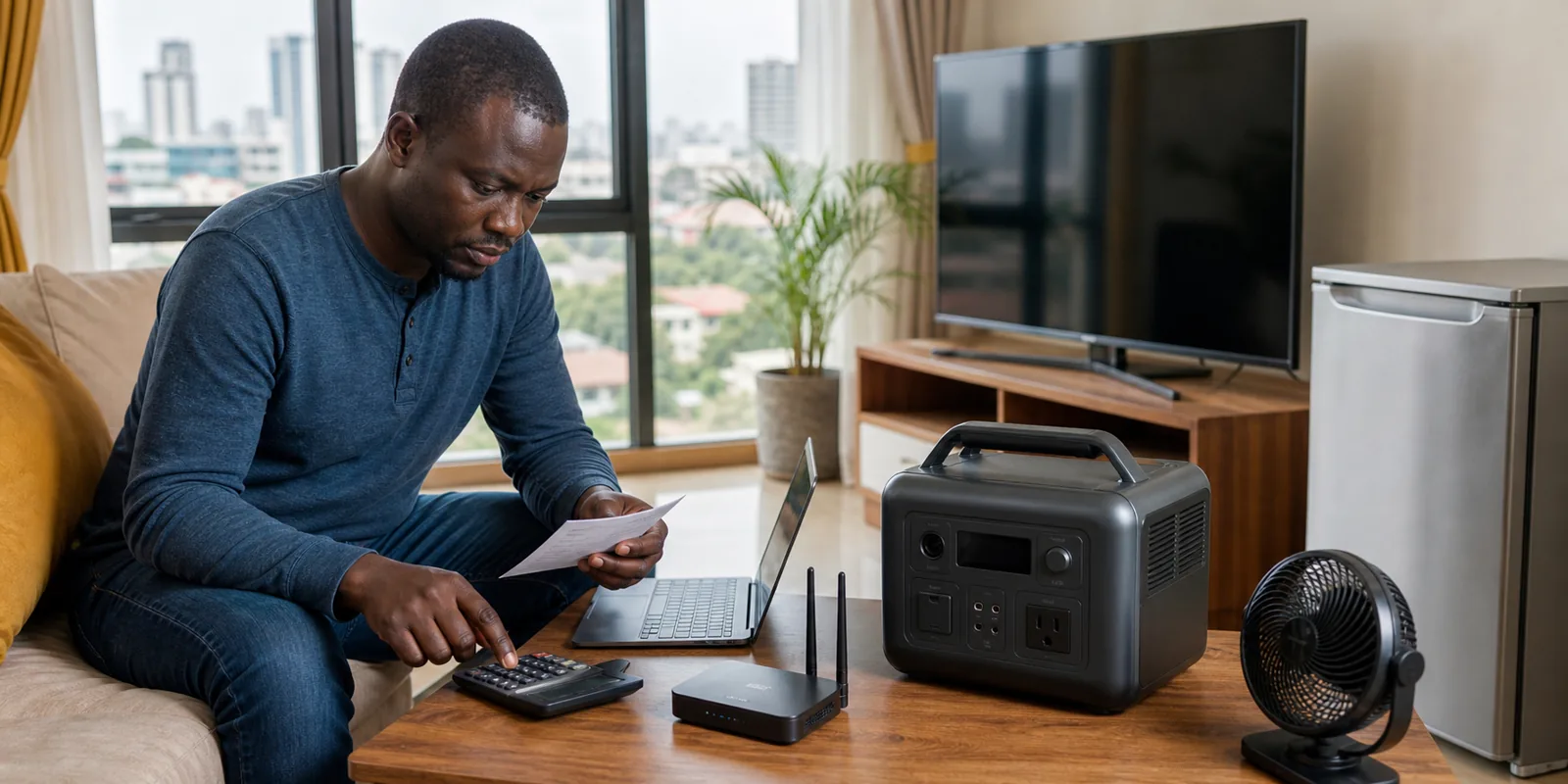
People using the search phrase portable power station size Kenya should begin with a load list, not a brand name or a seller's appliance count. A unit that keeps a router and two lights running through an evening may be far too small for a refrigerator, kettle or printer. A larger unit may be unnecessary if the real requirement is only internet and laptop continuity.
The useful comparison has two separate numbers: energy capacity in watt-hours and output power in watts. You also need the correct outlets, charging inputs and a model intended for the electrical environment in which it will be used. This guide gives you a repeatable way to compare listings without treating an estimated runtime as a guarantee.
Start with the devices that must stay on
Write down only the devices you genuinely need during an outage. Separating essentials from conveniences can reduce the required battery size and cost.
For every device, record:
- the wattage on its nameplate, charger or official manual;
- how many units will run at the same time;
- the number of hours each device must operate;
- whether it has a motor, compressor or heating element;
- the plug or USB connection it needs; and
- whether it can run directly from USB-C or DC instead of an AC socket.
Do not rely on a generic statement such as “powers a laptop for ten hours.” Laptop consumption changes with screen brightness, processor load, battery charging and charger efficiency. Router adapters, televisions and refrigerators also vary. If the label gives volts and amps instead of watts, consult the manual or a competent technician rather than guessing at a high-risk load.
Understand watt-hours and watts
These terms answer different questions.
Watt-hours (Wh) describe stored energy. A 256Wh battery contains less nominal energy than a 768Wh or 1,024Wh battery. Watt-hours are the starting point for estimating how long a load may run.
Watts (W) describe the rate at which power is being used or supplied. A power station's continuous AC output must support the combined devices operating at one time. Some appliances also draw a brief startup surge that is higher than their normal running load.
A large capacity does not automatically mean a unit can run a high-power appliance. Likewise, a high output rating does not mean long runtime if the battery is small. Check capacity, continuous output and any separately stated surge rating on the exact model's manual or nameplate.
The EcoFlow global power-station series page illustrates the distinction. It currently lists examples ranging from RIVER units around 245–768Wh to DELTA units around 960–3,072Wh, with different output ratings. Those figures identify model classes; they do not promise a particular runtime in a Kenyan home.
Calculate a first-pass energy requirement
Use this simple planning formula for each device:
device watts × hours required × quantity = watt-hours required
Add the results for all devices. For example, suppose an illustrative home-office plan contains:
- one 10W router for 6 hours: 60Wh;
- one laptop averaging 45W for 4 hours: 180Wh; and
- one 8W LED light for 5 hours: 40Wh.
The arithmetic total is 280Wh. That does not mean a nominal 280Wh station will deliver the plan exactly. The inverter and power electronics consume energy, some capacity may be unavailable at protection limits, loads change, and batteries should not be selected with no reserve. Use the manufacturer's load guidance, then leave a practical margin for uncertainty and battery ageing.
For a reference point, EcoFlow's official DELTA 2 product page states a nominal 1kWh capacity and publishes model-specific runtime examples. The page also makes clear that its examples depend on the stated test loads. Apply the method to your own measured or labelled devices rather than copying a marketing example.
Treat motors and heating appliances differently
Routers, LED lights and charged laptops are relatively straightforward loads. Refrigerators, pumps and some power tools can demand substantially more power while starting. Kettles, irons, cookers and heaters convert electricity into heat and can drain a portable battery quickly.
Before including one of these appliances:
- Check its rated running wattage.
- Find the manufacturer's startup or surge requirement where applicable.
- Confirm that the power station's normal and surge output cover it.
- Ask whether other devices may be running at the same time.
- Use the power-station manual to confirm that the load type is supported.
Features that modify voltage or allow some appliances to operate above the ordinary output rating are not the same as native continuous output. They may not suit equipment that requires stable voltage. Use the exact manufacturer's explanation and test only within the instructions.
A practical capacity-band approach
Capacity bands can help you shortlist, but they are not appliance guarantees.
Around 200–300Wh
This class can be useful for low-power electronics such as a router, phones, LED lighting and limited laptop charging. Count the number and type of ports carefully. A small unit with one AC socket may still be convenient if most loads use USB.
Around 500–800Wh
This middle class can provide more reserve for a workday setup, several electronics or longer lighting requirements. Weight and recharge time increase, so portability and charging method matter more.
Around 1kWh and above
Larger units may suit longer outages or selected appliances, provided their output and surge limits match. They are heavier and more expensive, and the buyer should plan where the unit will be used, charged and stored.
Do not jump to the largest battery without checking the load. A better result may come from powering only essentials, using efficient lights, charging a laptop directly through a suitable USB-C port, or running a refrigerator intermittently according to safe food-storage guidance.
Check the outputs, not just capacity
After estimating energy, inspect the actual connection options:
- AC socket type, voltage and frequency for the intended equipment;
- combined continuous AC output;
- USB-C Power Delivery wattage for compatible laptops and phones;
- USB-A and DC output limits;
- whether shared ports reduce total available output;
- solar-input voltage, current and connector limits; and
- AC charging input and supplied charging cable.
A foreign-market unit may have an unsuitable socket, voltage or warranty route. An adapter changes the physical plug but does not convert voltage or prove that the equipment is approved for the intended use. Confirm the exact regional version before paying.
Do not ignore battery condition and safety
Portable power stations contain high-energy rechargeable batteries. The US Consumer Product Safety Commission lists standards work addressing overheating, fire and explosion hazards for high-energy batteries and portable power packs on its battery safety page.
Buyers should reject a unit with swelling, impact damage, liquid exposure, burnt connectors or an unreadable identity label. Use only charging equipment approved for the exact model. Keep ventilation openings clear, follow the operating-temperature limits, and do not dismantle or improvise battery connections. For used equipment, request its history and understand that displayed charge cycles alone may not reveal damage or storage abuse.
Portable power station comparison checklist
Before comparing the final price, confirm:
- exact manufacturer, model number and regional version;
- nominal capacity in Wh;
- battery chemistry stated by the manufacturer;
- continuous and surge output ratings;
- your simultaneous load and required runtime;
- AC, USB-C, USB-A and DC port limits;
- compatible AC and solar charging specifications;
- included cables and accessories;
- readable serial number and proof of purchase;
- written seller warranty terms and service location;
- final price, delivery or pickup arrangement; and
- return terms if the delivered model differs from the listing.
JAAT helps shoppers discover and compare products, but a listing is not a substitute for the exact manual, a load calculation or confirmation from the relevant seller. Read the JAAT buyer tips, review how JAAT describes trust and buyer checks, and check the applicable shipping and delivery information before committing.
Compare a shortlist on JAAT
Once your load sheet is ready, use this portable power station size Kenya checklist while browsing the JAAT electronics category. Compare only units that meet the required capacity, output and connection checks. Contact the relevant seller to confirm current availability, the final price, the exact regional model, warranty responsibility, delivery terms and payment method. A clear calculation makes that conversation faster and helps prevent paying for either too little backup or capacity you do not need.